
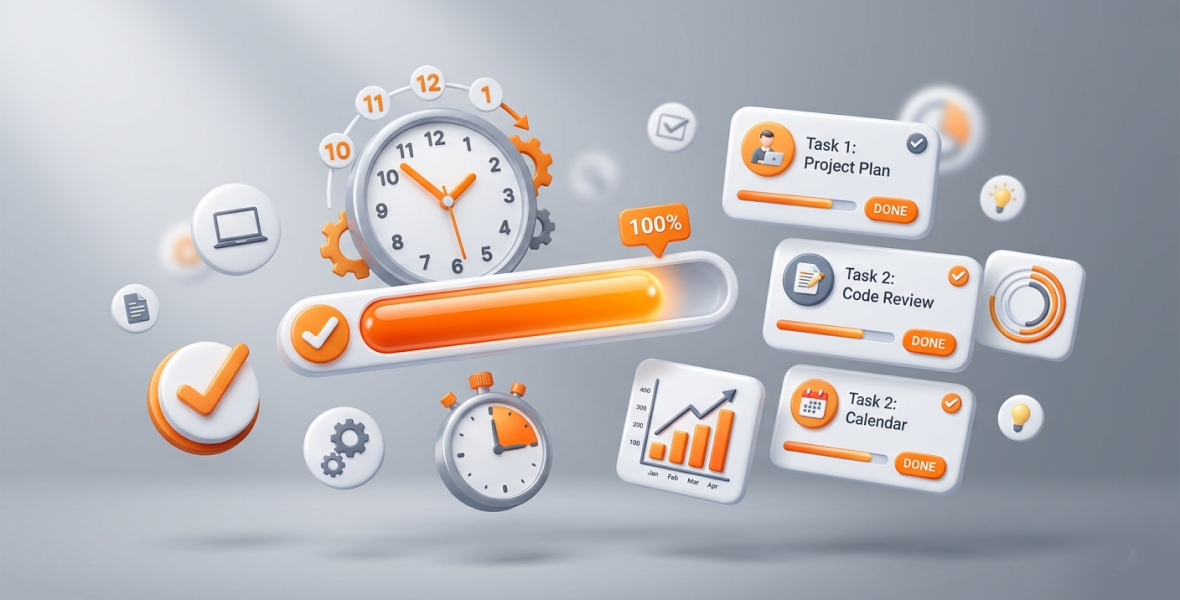
Every startup needs a time tracking tool because time is its scarcest resource, and you can't manage what you can't see. A tool like TimoDesk shows founders where the team's hours go, which tasks run over, and who is overloaded. It costs $1 per user per month, so even an early team can afford real data.
Startups move fast with small teams, tight budgets and high expectations. Yet many still rely on gut feeling and scattered spreadsheets to judge how time is spent. This article explains what time tracking software does, why it matters for startups, and how TimoDesk helps without adding complexity.
Why does every minute matter in a startup?
Startups have little room for waste. You can't hire without limit, and customers, investors and co-founders all expect a lot from every person.
Time is the one resource you can't get back. You can raise money and hire people, but you can't buy more hours. Poor time management leads to missed deadlines, burnout, unclear priorities and lost revenue.
Common struggles in early-stage companies include:
- Founders wearing many hats (sales, product, operations) with no view of the real effort.
- Teams juggling client work, product development and marketing without clear ownership.
- Remote or hybrid setups that make communication gaps bigger.
- Trouble showing investors where time and money went.
TimoDesk tackles these problems with time tracking, activity levels, app and website usage, reports and screenshots. It costs $1 per user per month with every feature, and there are no tiers to outgrow.
What is time tracking software?
Time tracking software records how people spend their working hours. It captures time on tasks and projects, plus apps, websites and activity levels, and turns it into reports and timesheets.
The core idea: instead of relying on memory or hand-written logs, which are often wrong, the tool records time while people work.
How it works:
- A desktop app records time while a timer runs.
- It checks for keyboard and mouse input to spot idle time.
- Time is linked to projects and tasks.
- Data goes to a central dashboard for managers and founders.
Manual vs. tracked time:
- Manual (spreadsheets or basic timers): cheap, but easy to forget or guess. It leads to gaps and disputes.
- Tracked: the app records time in the background once the timer starts. It removes idle time and can add proof like screenshots.
Features startups should look for:
- A simple task timer with idle detection.
- App and website usage.
- Live dashboards and reports.
- Projects and tasks in the same tool.
- Offline tracking and support for Windows, macOS and Linux.
- A low, predictable price.
- Clear privacy settings.
TimoDesk covers all of these with its desktop app and web dashboard.
Why is time management critical for startups?
Startups have small margins for error. With a limited budget and few people, every hour must count.
Founders also need to make fast decisions and change direction based on real data, not guesses. As the team grows from 5 to 50, visibility disappears unless you have a system.
Poor time management hurts growth:
- Late product launches give competitors an opening.
- Overworked teams lead to people quitting.
- Poor planning means missed investor milestones.
Time data turns chaos into clarity. It helps startups do more with the people they already have. Read more on why every business needs a time tracker.
What problems do startups face without time tracking?
Unclear work hours: many teams guess at how much focused work happens each week.
Missed deadlines: you don't see bottlenecks until it is too late.
Low visibility: founders can't see who is working on what.
Poor task allocation: your best people get stuck on low-impact work.
Burnout: without data, nobody notices when someone works long days for weeks.
Lost revenue: billable hours go unrecorded, and wasted time goes unnoticed.
For a startup on a short runway, these problems are serious.
How does time tracking improve startup productivity?
Accountability: everyone can see their own data, and people tend to adjust on their own.
Focus: seeing where distractions happen helps build better habits.
Transparency: remote and hybrid teams build trust when everyone sees the same facts.
Better decisions: spot bottlenecks, move people and plan with real numbers.
Better workflows: find time sinks and simplify processes.
Why is TimoDesk a smart choice for startups?
TimoDesk is a time tracking and team productivity tool for remote, hybrid and in-house teams. It combines time tracking, project management, activity levels and reports in one place.
Core benefits for startups:
- A timer on each task, with idle time removed on its own.
- Real data instead of guesswork.
- $1 per user per month with every feature and no tiers.
- Quick setup for fast-moving teams.
Platforms: desktop apps for Windows, macOS and Linux, with offline tracking that syncs when the app reconnects within 30 days.
What stands out:
- Screenshots every 3 to 60 minutes, switched on or off for each member.
- The Live Team Monitor browser extension shows who is online.
- Staff see only their own data, and typed text is never recorded.
- No seat minimum and no annual contract.
What are TimoDesk's key features for startups?
Time tracking
Start the timer on a task in the desktop app. It records time against the task and project in the background. This suits developers and marketers who don't want admin work.
Live activity view
The Live Now view on the dashboard and the Live Team Monitor extension show who is working at the moment. You get visibility without asking for status updates.
App and website usage
See which apps and websites were used during tracked time, such as Figma, VS Code or social media. TimoDesk does not label apps as productive or unproductive; you decide what matters for your team.
Reports and analytics
Daily, weekly and monthly reports show activity levels, project time and trends. You can download the main reports as PDF or CSV for investor updates or your own payroll process.
Idle time detection
When there is no keyboard or mouse input for the timeout you set (3 to 60 minutes), that time is removed. Your data reflects real work.
Projects and tasks
Each project has a kanban board, list and calendar view. Tasks have priority, due dates, estimates and comments. TimoDesk flags tasks that go over their estimate.
What are the benefits of TimoDesk for startups?
Get more done without hiring
Use your current team better instead of adding headcount. Reports show which tasks matter most and where time leaks. The team can then focus on what moves the company forward.
Stronger accountability
When people can see their own data, they take more ownership. Staff see their own reports, and everyone who tracked time gets a daily summary email. Less supervision is needed.
Better project management
Live boards and tracked time show progress clearly. Managers can assign tasks, watch deadlines and change priorities. The dashboard flags overdue tasks and tasks over estimate.
Lower costs
Reports show where time and money are wasted, such as long meetings or stalled tasks. And the tool itself costs only $1 per member who tracked time.
An open work culture
When data is shared fairly, there is less guessing and fewer misunderstandings. People feel measured fairly, which builds trust.
How does time tracking help remote and hybrid startup teams?
Many startups are fully remote. That brings communication gaps, time zone differences and little visibility into output.
TimoDesk helps with time tracking, live views and screenshots. Managers get facts without constant check-ins, and the team keeps its independence. Offline tracking keeps data complete for a team spread from Dhaka to San Francisco.
How does TimoDesk help founders make better decisions?
Founders see bottlenecks, team workload and capacity based on data. You can spot who has room for more work, judge when to hire, and plan growth on real numbers instead of stories.
Who in a startup should use TimoDesk?
- Founders and CEOs: a high-level view for strategy and investor updates.
- Project managers: deadlines, workloads and task estimates.
- Developers: coding time compared with meeting time.
- Marketing teams: time spent on campaigns and content.
- Contractors: accurate hours and proof of work.
How does TimoDesk compare with traditional time tracking?
| Aspect | Spreadsheets and basic timers | TimoDesk |
|---|---|---|
| Accuracy | Depends on memory, often wrong | Records time while the timer runs, idle time removed |
| Admin time | Manual entry every week | Timesheets built from tracked time |
| Live view | None | Live Now view and browser extension |
| Proof of work | None | Screenshots and activity levels |
| Price | Often free | $1 per user per month, every feature |
| Growing the team | Gets messy fast | No seat minimum, same plan for every size |
| Projects and tasks | Separate from time data | Built in, linked to tracked time |
How do you address employee concerns about monitoring?
Privacy worries are fair. TimoDesk only tracks while a member's timer runs. Staff see only their own data, typed text is never recorded, and screenshots are set per member. Explain your policy clearly: this is for growth, not punishment. Share team-level insights and involve people in setting goals.
What are the best practices for startups using time tracking?
- Set clear goals, such as better estimates or fewer late tasks.
- Avoid micromanagement. Use the data for coaching.
- Review reports together, not as a punishment.
- Ask for feedback and offer training.
- Connect tracking to your company goals, such as OKRs.
What mistakes should startups avoid?
- Monitoring too much, which breeds resentment.
- Collecting data and never acting on it.
- Skipping team training.
- Choosing a tool that is too complex.
- Tracking things that don't match your business goals.
What does this look like in a real startup?
Picture a 12-person SaaS startup with missed deadlines and a tired founder. Before tracking, effort is scattered and progress is unclear. After a few weeks of TimoDesk, the reports show that marketing spends much of its time on low-value tasks, and developers lose big parts of their day to meetings. The team cuts meetings, moves marketing work around and adds estimates to tasks. Deadlines become easier to hit, and the founder can show investors clear data on where time goes.
What is the future of time tracking in startups?
Time tracking is moving from simple timers to tools that show how work really happens. Trends across the market include earlier warnings about overload, more privacy controls and, from some vendors, AI features. TimoDesk does not have AI features, but its dashboard already flags overdue tasks, low activity, long workdays and tasks over estimate.
Startups that adopt tracking early build good habits before the team grows, which makes scaling smoother.
How do you get started with TimoDesk?
- Sign up for the 15-day free trial. No card is needed.
- Download the desktop app for your system.
- Invite team members by email or with an invitation link.
- Create projects and tasks, and choose tracking settings.
- Members start the timer, and the first data appears right away.
Setup takes minutes. On a Mac, members allow a few permissions the first time.
Conclusion
Startups win or lose on execution, and execution depends on time. Without visibility, you are guessing. TimoDesk gives you clear data on time, tasks and workload, so you can use limited resources well and support a remote team.
Time tracking is not about control. It is about clarity. At $1 per user per month, it is easy to try. Start your free trial and see where your startup's time goes.
Frequently asked questions
Why do startups need a time tracking tool?
Startups have little time and money to waste. A time tracking tool shows where hours go, so founders can fix bottlenecks and plan with real data.
How much does TimoDesk cost for a startup?
TimoDesk costs $1 per user per month, with every feature on one plan. You pay only for members who tracked time that month, and there is a 15-day free trial.
Does TimoDesk have a free plan?
No. There is a 15-day free trial with no card. After that, the price is $1 per user per month.
Will time tracking hurt trust in a small team?
Not if you are open about it. Explain what is tracked and why, let people see their own data, and use reports for coaching rather than blame.
Was this helpful?
Share it with someone who still adds up hours by hand.