Decimal hours calculator
Convert hours and minutes to decimal hours and back, paste a whole week of times for a total, and print the minutes to decimal chart. Free, no sign-up, and nothing leaves your browser.
Time to decimal converter
Both sides update as you type.
Batch mode: paste a list of times
One time per line, with an optional label in front. You get each line in decimal and a total.
Reads 7:45, 8:05:30, 7h 50m, 45m, 7.5 and ranges such as 9:00-17:30 or 9am-5:30pm. A finish earlier than the start crosses midnight.
| Entry | Time | Decimal |
|---|
How to convert time to decimal
An hour has 60 minutes, not 100. That is the whole reason the conversion exists. A clock writes three quarters of an hour as :45, and a decimal writes it as .75. Payroll software, invoices and spreadsheets all multiply hours by a rate, so they need the decimal form.
decimal hours = hours + minutes ÷ 60 + seconds ÷ 3600
Example: 8:52 = 8 + 52 ÷ 60 = 8.8667, which rounds to 8.87.
minutes = (decimal hours − whole hours) × 60
Example: 4.6 hours = 4 hours and 0.6 × 60 = 36 minutes, so 4:36.
Worked examples: hours and minutes to decimal
| Clock time | The math | Hundredths | Tenths |
|---|---|---|---|
| 0:06 | 6 ÷ 60 = 0.1 | 0.10 | 0.1 |
| 0:20 | 20 ÷ 60 = 0.3333 | 0.33 | 0.3 |
| 1:45 | 1 + 45 ÷ 60 = 1.75 | 1.75 | 1.8 |
| 7:30 | 7 + 30 ÷ 60 = 7.5 | 7.50 | 7.5 |
| 8:52 | 8 + 52 ÷ 60 = 8.8667 | 8.87 | 8.9 |
| 2:10:30 | 2 + 10 ÷ 60 + 30 ÷ 3600 = 2.175 | 2.18 | 2.2 |
| 37:45 | 37 + 45 ÷ 60 = 37.75 | 37.75 | 37.8 |
Worked examples: decimal to hours and minutes
| Decimal | The math | Clock time |
|---|---|---|
| 0.25 | 0.25 × 60 = 15 minutes | 0:15 |
| 4.6 | 0.6 × 60 = 36 minutes | 4:36 |
| 7.83 | 0.83 × 60 = 49.8 minutes | 7:50 |
| 38.15 | 0.15 × 60 = 9 minutes | 38:09 |
7.83 hours is 7 hours 49 minutes 48 seconds, which rounds to 7:50. A decimal with two places can only land on a 36-second step, so converting back may be a few seconds off.
Once hours are decimal, pay is one multiplication. A week of 38:24 is 38 + 24 ÷ 60 = 38.4 hours. At $18.50 an hour, that is 38.4 × 18.50 = $710.40. If someone typed 38.24 instead, the pay would come out at $707.44, almost $3 short, every week. Hours over a weekly limit may be paid at a higher rate; the overtime calculator splits those out.
Minutes to decimal hours chart
Every minute from 1 to 60, in hundredths and in tenths of an hour. Print it and keep it next to the timecards. Add the whole hours yourself: 6 hours 38 minutes is 6 + 0.63 = 6.63.
Minutes to decimal hours chart (timodesk.com/tools/decimal-hours-calculator)
| Min | Hundredths | Tenths |
|---|---|---|
| 1 | 0.02 | 0.0 |
| 2 | 0.03 | 0.0 |
| 3 | 0.05 | 0.1 |
| 4 | 0.07 | 0.1 |
| 5 | 0.08 | 0.1 |
| 6 | 0.10 | 0.1 |
| 7 | 0.12 | 0.1 |
| 8 | 0.13 | 0.1 |
| 9 | 0.15 | 0.2 |
| 10 | 0.17 | 0.2 |
| 11 | 0.18 | 0.2 |
| 12 | 0.20 | 0.2 |
| 13 | 0.22 | 0.2 |
| 14 | 0.23 | 0.2 |
| 15 | 0.25 | 0.3 |
| Min | Hundredths | Tenths |
|---|---|---|
| 16 | 0.27 | 0.3 |
| 17 | 0.28 | 0.3 |
| 18 | 0.30 | 0.3 |
| 19 | 0.32 | 0.3 |
| 20 | 0.33 | 0.3 |
| 21 | 0.35 | 0.4 |
| 22 | 0.37 | 0.4 |
| 23 | 0.38 | 0.4 |
| 24 | 0.40 | 0.4 |
| 25 | 0.42 | 0.4 |
| 26 | 0.43 | 0.4 |
| 27 | 0.45 | 0.5 |
| 28 | 0.47 | 0.5 |
| 29 | 0.48 | 0.5 |
| 30 | 0.50 | 0.5 |
| Min | Hundredths | Tenths |
|---|---|---|
| 31 | 0.52 | 0.5 |
| 32 | 0.53 | 0.5 |
| 33 | 0.55 | 0.6 |
| 34 | 0.57 | 0.6 |
| 35 | 0.58 | 0.6 |
| 36 | 0.60 | 0.6 |
| 37 | 0.62 | 0.6 |
| 38 | 0.63 | 0.6 |
| 39 | 0.65 | 0.7 |
| 40 | 0.67 | 0.7 |
| 41 | 0.68 | 0.7 |
| 42 | 0.70 | 0.7 |
| 43 | 0.72 | 0.7 |
| 44 | 0.73 | 0.7 |
| 45 | 0.75 | 0.8 |
| Min | Hundredths | Tenths |
|---|---|---|
| 46 | 0.77 | 0.8 |
| 47 | 0.78 | 0.8 |
| 48 | 0.80 | 0.8 |
| 49 | 0.82 | 0.8 |
| 50 | 0.83 | 0.8 |
| 51 | 0.85 | 0.9 |
| 52 | 0.87 | 0.9 |
| 53 | 0.88 | 0.9 |
| 54 | 0.90 | 0.9 |
| 55 | 0.92 | 0.9 |
| 56 | 0.93 | 0.9 |
| 57 | 0.95 | 1.0 |
| 58 | 0.97 | 1.0 |
| 59 | 0.98 | 1.0 |
| 60 | 1.00 | 1.0 |
Hundredths are minutes × 100 ÷ 60, rounded to two places. Tenths are minutes ÷ 6, rounded to the nearest whole tenth, so 1 to 2 minutes is 0.0, 3 to 8 minutes is 0.1, and so on.
Hundredths or tenths?
Both are correct. They differ in how fine the steps are, and your payroll system or contract decides which one to use.
- Each step is 0.01 hour, which is 36 seconds
- 15 minutes is 0.25, 20 minutes is 0.33, 52 minutes is 0.87
- The usual choice for modern payroll and spreadsheets
- Small rounding differences, at most 18 seconds per entry
- Each step is 0.1 hour, which is 6 minutes
- 15 minutes is 0.3 (rounded up from 0.25), 52 minutes is 0.9
- Used by employers and firms that record time in 6-minute units
- Coarser: one entry can move by up to 3 minutes
Rounding clock-in and clock-out times is a separate question from converting them. In the US, the federal rule at 29 CFR 785.48 accepts recording start and stop times to the nearest 5 minutes, or to the nearest tenth or quarter of an hour, as long as the practice does not, over time, fail to pay people for all the time they worked. States and other countries can set their own rules, so check your local law before you round anyone's time.
Six ways decimal hours go wrong
Each of these turns up on real timesheets. Most of them underpay by a few minutes a day, which nobody notices until it adds up.
- Reading the colon as a decimal point 7:30 typed as 7.30 loses 12 minutes. The right value is 7.5. On a $25 rate that is $5 gone from one day.
- Rounding every line, then adding Small roundings stack up. Add the exact minutes first, then round the total once. The batch mode above does it in that order.
- Counting 100 minutes in an hour 1.75 hours is not 1 hour 75 minutes. It is 1 hour 45 minutes, because 0.75 × 60 = 45.
- Cutting off instead of rounding 10 minutes is 0.1667. Cutting it to 0.16 instead of rounding to 0.17 shaves a little off every entry.
- Mixing tenths and hundredths If one sheet uses 0.3 for 15 minutes and another uses 0.25, totals will not match. Pick one convention for the whole pay period.
- Converting before taking off breaks Subtract unpaid breaks in minutes first, then convert. The work hours calculator does the subtraction for you.
Start with hours that are already right
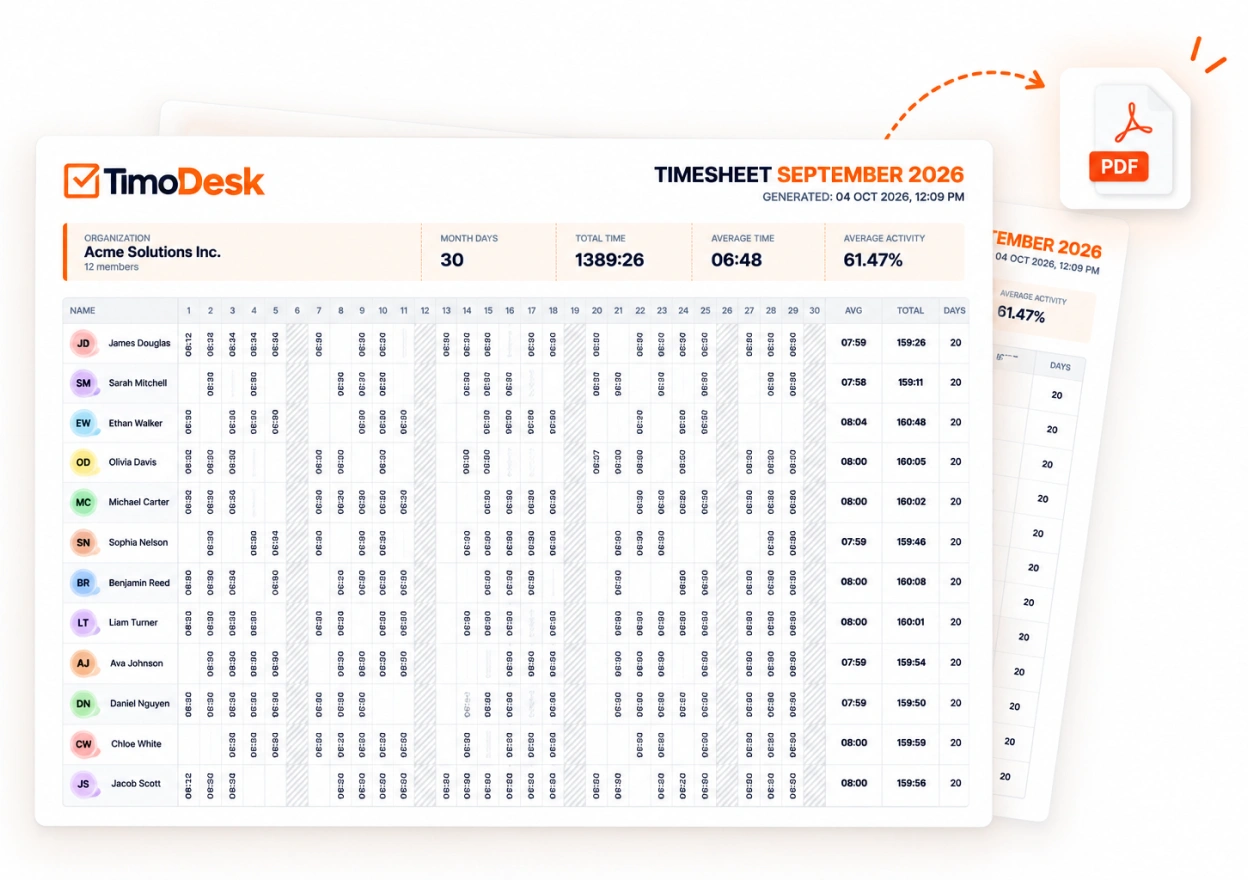
A perfect conversion of a guessed number is still a guess. TimoDesk records time while people work, from a desktop timer, and adds it up for you. The monthly timesheet shows each person's days and month total in hours and minutes, ready to export as PDF. Paste the totals into the batch mode above when payroll wants decimals.
- Desktop timer for Windows, macOS and Linux
- Weekly worklogs and monthly timesheets built automatically
- Manual time requests with approval, kept apart from tracked time
- $1 per user per month, every feature included
About decimal hours
Converting time to decimal, rounding, payroll math and the batch mode, in plain words.
How do I convert hours and minutes to decimal hours?
Divide the minutes by 60 and add the result to the whole hours. For example, 7 hours 45 minutes is 7 + 45 ÷ 60 = 7.75 hours. If there are seconds, divide them by 3,600 and add them too.
How do I convert decimal hours back to hours and minutes?
Keep the whole number as hours, then multiply the decimal part by 60 to get minutes. For example, 6.4 hours is 6 hours and 0.4 × 60 = 24 minutes, so 6:24.
What is 7 hours 30 minutes in decimal?
7.5 hours. It is not 7.30, because the 30 after the colon is minutes, and 30 minutes is half of an hour. Reading the colon as a decimal point is the most common timesheet mistake.
What is 15, 20, 30 or 45 minutes as a decimal?
15 minutes is 0.25 hours, 20 minutes is 0.33, 30 minutes is 0.5 and 45 minutes is 0.75. The full chart on this page lists every minute from 1 to 60 in hundredths and in tenths.
What is the difference between hundredths and tenths of an hour?
Hundredths use two decimal places, and each 0.01 is 36 seconds. Tenths use one decimal place, and each 0.1 is 6 minutes. Hundredths are more precise. Tenths are used by employers and firms that count time in 6-minute units.
Should I round each day or only the weekly total?
Add the exact minutes first and round once at the end. Rounding every line can drift. Three entries of 20 minutes round to 0.33 each, which adds up to 0.99, while the exact total is 1 hour, or 1.00.
Is it legal to round employee time?
In the US, the federal rule at 29 CFR 785.48 accepts rounding start and stop times to the nearest 5 minutes, tenth or quarter of an hour, as long as it does not underpay people over time. Other places have their own rules, so check your local law.
How do I calculate pay from decimal hours?
Multiply the decimal hours by the hourly rate. For example, 37 hours 45 minutes is 37.75 hours, and 37.75 × $22 = $830.50. Multiplying 37.45 by the rate instead would underpay by $6.60.
Can the batch mode handle seconds and overnight shifts?
Yes. It reads h:mm:ss durations, values like 7h 50m, plain decimals, and start to finish ranges such as 22:00-06:30. A finish earlier than the start is counted as crossing midnight.
Does TimoDesk convert hours to decimal for me?
TimoDesk records the hours while people work and adds them up in weekly worklogs and monthly timesheets, shown in hours and minutes, with PDF export. Paste those totals into the batch mode here when payroll needs decimals.
Start tracking time this week
Create your organization and invite your team today. Tracked time shows on the dashboard the same day, and the first full-day reports are ready the next day. $1 per user per month, with every feature included.
- $1 per user / month
- 15-day free trial, no card
- Stop anytime. No contract.
