
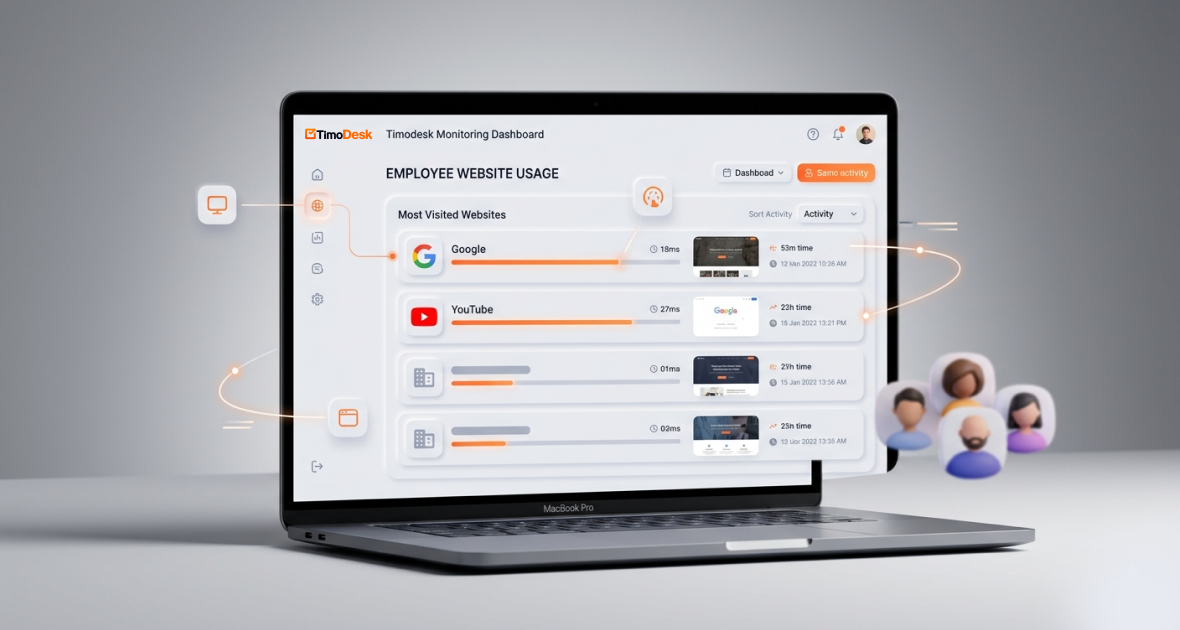
Employee website monitoring shows which websites your team visits during work time and how long they spend on each one. In TimoDesk, websites are recorded only while a member’s timer runs, along with the page address, page title and browser, never the page content. Managers use it to spot distractions, link web time to tasks and coach with facts.
The internet is essential for work, but it is also a big source of distraction. People drift into social media, news or streaming. These small breaks add up to missed deadlines and lower output.
For managers, the challenge is visibility. It is hard to know how online time is spent, especially in remote and hybrid teams.
TimoDesk website and app usage shows the top websites for each member, project and task, next to tracked time and activity levels. It costs $1 per user per month, with every feature on one plan.
Why does monitoring employee website usage matter?
Website monitoring is not about catching people out. It is about understanding work patterns and building a fair, accountable culture.
- Find distracting websites: Video, social media, news and streaming sites are common time sinks. When you see which sites take the most time, you can fix the cause.
- Understand work patterns: Data shows which tools people rely on and where time goes. You might find designers need more research time than planned.
- Work more efficiently: When web time is linked to tasks, teams can cut low-value browsing and reduce context switching.
- Support remote accountability: Remote workers face more temptations. Open website data builds trust through facts, not assumptions.
- Make reviews fair: Instead of “you seem distracted,” managers can say: “A lot of time went to news sites last week. Can we make your research faster so you have more time for client work?”
What problems do teams face without website monitoring?
- Too much time on unrelated sites: Social media, video and news browsing can quietly take a big part of the day.
- No view of work hours: Managers know output is down but can’t see why. They can’t tell focused research from aimless scrolling.
- No link between web time and tasks: A developer may look busy online but spend hours on unrelated forums. Projects slip quietly.
- Missed deadlines: Every interruption has a cost. Research by Gloria Mark at UC Irvine found it can take over 20 minutes to get back to a task after an interruption.
- Overestimated productivity: Self-reported productivity often looks better than reality. Leaders end up deciding on hope, not evidence.
These problems also raise stress and burnout, and quietly push up costs.
How does employee website monitoring work?
Website monitoring software records the websites used on work computers and the time spent on each. Here is how it works in TimoDesk:
- What is recorded: The website, the page address (URL), the page title and the browser. Never the content of the page.
- When it is recorded: Only while the member’s timer runs in the desktop app. Nothing is recorded when the timer is off. Idle time is removed.
- Linked to work: Website usage is shown per member, project and task, so you see the work context.
- On every platform: On Windows and macOS, the desktop app reads website addresses itself. On Linux, install the TimoDesk URL Tracker extension for Chrome or Firefox.
Some monitoring tools sort websites into “productive” and “unproductive” groups and give scores. TimoDesk does not. It shows the data, and managers decide what counts as work for each role.
Staff see only their own data, and organizers and managers see the team. Data is encrypted in transit. Read more on our security page.
What are TimoDesk’s key features for website monitoring?
| Feature | What it does |
|---|---|
| Website tracking | Records sites, page addresses, page titles and browsers while the timer runs |
| Top websites | Ranks the websites used across the team or for one member by time spent |
| Per project and task | Shows which sites each piece of work needed |
| Dashboard | Shows tracked time, activity levels, who is working now and low-activity alerts |
| Reports | The websites and URLs report downloads as PDF or CSV |
| Screenshots | Optional, switched per member, for extra context |
| Offline | The app keeps tracking offline and syncs when it reconnects |
Website data does not live alone. Because it is linked to tasks and projects, you can see whether time on a site helped the work.
How do you set up website monitoring in TimoDesk?
- Create your account: Start the 15-day free trial and invite your team by email.
- Tell your team: Explain what is recorded, when and why.
- Install the app: Members install the desktop app. Linux users also add the URL Tracker extension.
- Agree on core sites: List the websites each role needs for work, so reviews are fair.
- Track on tasks: Members start the timer on their task, so web time is linked to work.
- Review reports: Check top websites weekly for the team and for each member.
- Coach: Turn findings into supportive conversations.
What are the best practices for website monitoring?
- Be open about your monitoring policy, and explain the reasons.
- Focus on better work, not punishment.
- Review reports regularly instead of policing every day.
- Combine website data with time and task data for context.
- Celebrate when teams cut distractions.
How do different teams use website monitoring?
- Remote teams: Marketing teams see how much time goes to news sites and how much to research tools, and adjust. See TimoDesk for remote teams.
- Agencies: Design agencies compare time on inspiration sites and social media with project deadlines.
- Software teams: Developers see time on documentation sites, and cut extra tab switching.
- Support teams: Leaders check that web time centers on the helpdesk and CRM, not personal browsing.
What are the benefits of website monitoring with TimoDesk?
Website monitoring helps teams stay focused, accountable and aligned with goals. By finding time spent on non-work websites, teams can win back focus time. Work hours line up better with tasks and project priorities. Managers get facts for coaching and better workflows.
Over time, these small changes add up to stronger performance.
What mistakes should you avoid?
- Monitoring in secret: It damages trust right away.
- Ignoring context: Some “non-work” sites support research, and short breaks are normal.
- Only looking at bad habits: Praise good use of time too.
- Using many disconnected tools: It creates data silos and admin work.
- Not acting on reports: Data without action is pointless.
How can you get the best results?
Update your list of core websites as tools change. Use reports to find good patterns and share them. Combine website data with task and project tracking for the full picture. Coach people based on what you see instead of micromanaging.
Celebrate progress in public. With the right approach, website monitoring becomes a tool for growth, not control.
Conclusion
Monitoring employee website usage with the right tool shows hidden time leaks and links effort to results. TimoDesk records websites while the timer runs, links them to projects and tasks, and gives you clear reports for $1 per user per month.
Start your 15-day free trial and see which websites your team visits most.
Frequently asked questions
Is website monitoring ethical for employees?
Yes, when people are told clearly and it covers only work time on work devices. TimoDesk records websites only while the timer runs and never records page content.
Does TimoDesk sort websites into productive and unproductive?
No. TimoDesk shows which websites were used and for how long. Managers decide what counts as work for each role.
Can remote teams be monitored without hurting morale?
Yes, if you are open and use the data for coaching. Staff see only their own data, and fair, fact-based reviews can lift morale.
How often can I get website usage reports?
Any time. Pick a day, week or custom date range in the dashboard. The websites and URLs report downloads as PDF or CSV.
Was this helpful?
Share it with someone who still adds up hours by hand.